When AI Is Good at Getting Things Done, What Is Left for People?
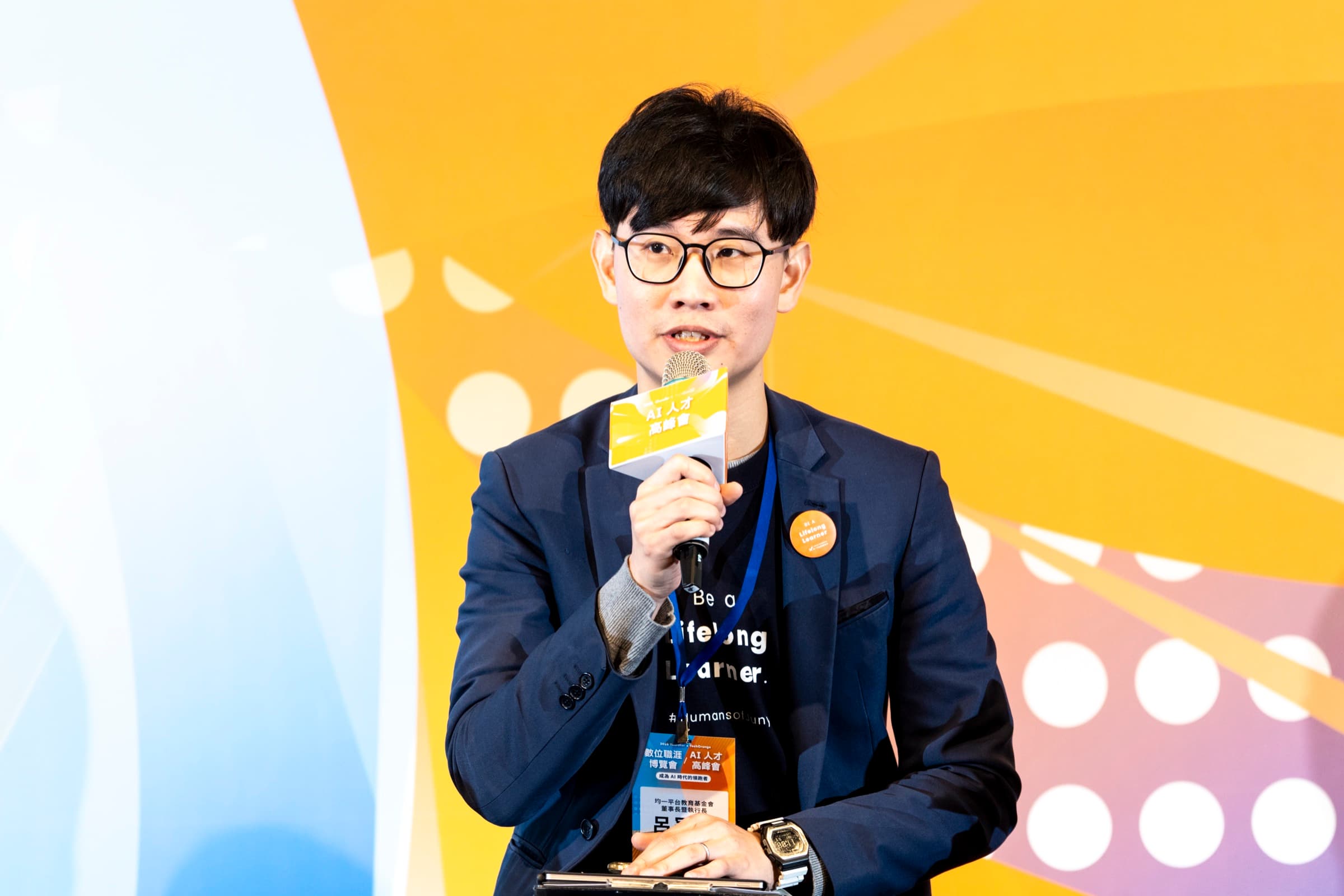
On the afternoon of my 39th birthday, at National Taiwan University (NTU), I asked 500 younger schoolmates: “If you used Junyi Academy at any point from elementary school through senior high school, please raise your hand.” About eighty percent of the hands went up.
In that moment I felt this was the best birthday present of the year. (I also added: if you thought Junyi used to be really hard to use, you are welcome to come find me after class.)
It was a full day. In the morning I was at NVIDIA discussing AI talent development; in the afternoon I went back to my alma mater to speak in the “Humanities and Technology” class. It also happened to be Professor Hung-yi Lee’s first day as an official board member of Junyi, and he (Teacher “Big Jin” in person, not the AI agent Teacher “Little Jin”) was there too, to announce together the MOU between Junyi and the NTU Artificial Intelligence Center of Research Excellence.
When AI is very good at getting things done, what is left for people?
The name Junyi originally comes from Mr. Stanley Yen’s Junyi elementary and secondary school in Taitung. Mr. Yen once said that education comes down to three things: learning how to be a person, learning how to live, and learning how to get things done.
In the age of AI, which of the three is most easily replaced? Probably “getting things done.” So I broke NTU into its three letters and offered them to my younger schoolmates:
N (National): Learn how to be a person by living together with others. Spend the time AI saves you on the people who matter.
T (Taiwan): Go out into the world, then turn back and get to know life in Taiwan.
U (University): Learn by doing at university. Do not only learn how to do things; practice asking whom you do them for, why you do them, and how to choose when you face trade-offs.
At the end I played the 2012 graduation music video of the Department of Medicine. I wrote the music; my best friend from university wrote the lyrics. More than ten years on, every year there are still students in their final year of senior high school leaving comments underneath: “Seniors, here I come.” None of this earned us a single extra cent, but that is what living is. (A colleague said the electric guitar solo in the middle was well arranged, so I am taking that as a birthday present. The old video is in the link.)
AI is a very powerful tool. But what I want even more is to invite everyone to be a super learner “with a soul.”
At 39, I have come to stand in the generation between the one before and the one after
In the talk, I mentioned three people.
When I was 19 and a university sophomore, I wanted to turn my private tutoring into small classes. A Dr. Yao asked me: “Do you have money?” No. “Do you have a space?” No again. “Then I’ll invest in you.” My first tutoring class opened in the basement of his dental clinic.
Later, Director Liu Chun-hao (劉駿豪) of Deshengzhe (得勝者), when he was starting up a new cram school, incorporated the brand-new student support service I had proposed. Later still, Brother Fang (方大哥) saw the videos I had recorded on YouTube and invited me to join Junyi with him.
This is how the generation before me nurtured me.
Then I also introduced two young colleagues.
Ben is a fellow alumnus ten years younger than me. In university he was a design intern at Junyi; later he studied at CMU and worked as a designer at Amazon. He saw the impact of AI on the front line and came back to build ActiveAI, an AI literacy platform. ActiveAI has now been integrated into Junyi, is being rolled out across all of Tainan, Pingtung and Yilan using “Ask, Use, Manage, Build (問用管造),” and has also become the main course of Taiwan’s Hour of AI.
Hao-Tien (顥天) is twenty years younger than me and is now a freshman at NYCU. He grew up teaching himself with Junyi, and today he is an official member of the Junyi team. He and I just co-wrote a paper on “cognitive security” and went to DC to present it.
At 39, I realized that I have come to stand in the middle: ahead of me are people who once held me up, and behind me are people waiting for a chance to begin. To be held up and then to hold up others is something AI cannot help with, yet it is the thing I most want to do well.
Being free of doubt may just mean not overthinking
In the last question of the Q&A, a student asked: we are told to do more in university, so where should we start? Or is it simply a matter of going and doing it?
I thought of what Jensen Huang said on his recent tour of Europe: perhaps Europeans are in the habit of overthinking everything. My answer was: as long as you are not breaking the law and not paying a price you cannot afford, go and do it.
Next year I turn 40. I used to think that “at forty, free of doubt” meant having figured everything out. Now I think it may mean knowing what is worth doing and whom you are doing it for, and then no longer thinking too much.
And what about my own birthday wishes at 39?
One: better English, so that I can communicate well internationally for Taiwan. I urged my younger schoolmates to go out into the world, so I have to do it first myself. This Friday I fly to Singapore to take part in an English debate together with teammates from Singapore and India.
Two: in this year of being 39, read through all 39 books of the Old Testament.
Psalm 90 says: “Teach us to number our days, that we may gain a heart of wisdom.”
May I number my days well this year and walk toward 40 with a wiser heart.
Thank you, NTU. Thank you to Professor Hung-yi, to Vice President for Academic Affairs Wang, who hosted, and to Vice President for International Affairs Yuan, who invited me. Thank you to every one of my younger schoolmates.
Thank you to every friend who sent me their good wishes. May you be healthy and at peace.
- Original: Ray Lu’s personal Facebook post (published 2026-10-21)
Course titles follow the source. Check each course page for its teaching language.
AI Fluency: Framework and foundations
Practice delegation, description, discernment, and diligence with the 4D framework. Free course; completion badge after assessment.
Dissecting the Crawfish: How AI Agents Work, via OpenClaw
An OpenClaw-based introduction to how AI agents work. Free public lecture; no self-study certificate. Costs of independently using external models or tools are separate.